The cloudy road ahead

In the next month or so, I and two friends will be attempting to cycle around Iceland.  Usually, there would be the standard helping of trepidation by friends and colleagues at the idea of cycling over a thousand miles, around a desolate and sparsely inhabited island.  This year is more ambitious than I had originally intended due to the continued eruption of Eyjafjallajökull.

Indeed, the repeated action of the volcano and the broad level of information I am receiving from various sources (some more trusted than others) means that I am none the wiser as to whether we will be able to fly to Iceland and then circumnavigate it without being either blocked by the volcanic activity or halted by falling clouds of ash.  Conundrums and tribulations aside, this is all adding up to be quite the adventure.  Usually, if I were only concerned about my own travel, this would not be an issue as one can more easily roll with the punches when you are solo.  However, with the much appreciated company on this trip, along with the variety of start points for the journey, I need to make sure that I am not going to waste anyone’s precious vacation time.

I must admit to being more than a little seduced by the adventure ahead.  Each year, I like to have something new, something that sets each challenge apart from the previous ones.  Last year, it was covering thousands of miles alone.  This year, Eyjafjallajökull is throwing all sorts of variables in my path.

I have read various reports from other cyclist and newscasters reporting back on the eruptions as they happen.  The official word was that they would be over within the next couple of weeks and that the prevailing winds would prevent any falling ash from inconveniencing us as we make our way clockwise around the island.
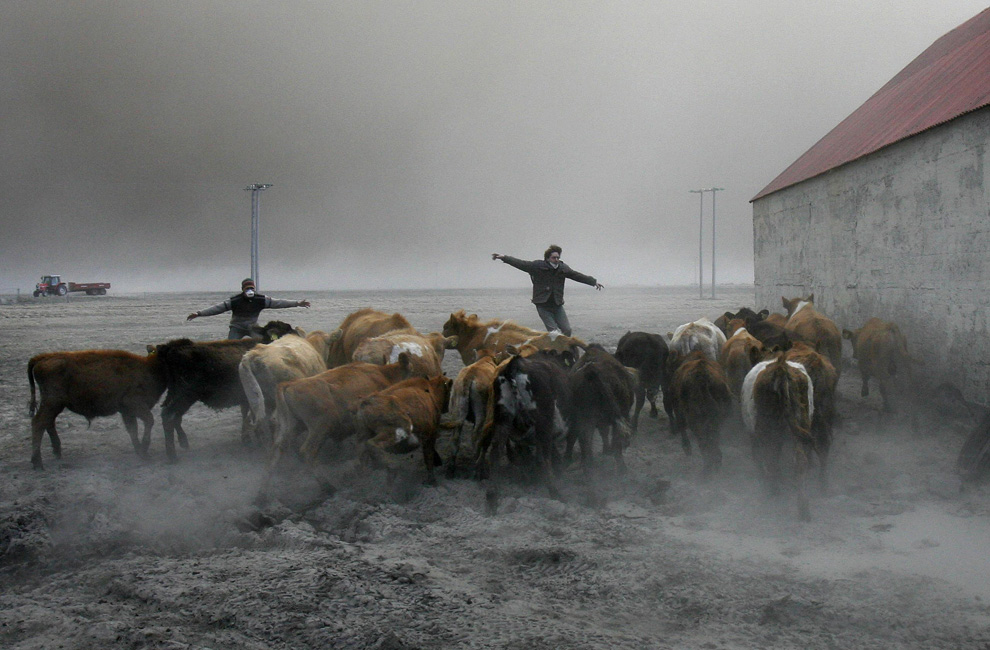
In addition to the complexities of Eyjafjallajökull erupting, its three previous eruptions on record have each been associated with a subsequent eruption of Katla.  So far, there have been no signs of turbulence beneath Katla’s surface.  However, having last erupted almost a century ago in 1918, vulcanologists say that a new blast is overdue.

“So far there have been no signs of the re-awakening of the Katla volcano but a lot of things can still happen, so we are monitoring it quite closely,” Dr Einarsson said.

Here is an image that caught my eye.  My cycling companion Dave summed it up best when he said something along the lines that we needed to make sure we had all a decent breathing mask in our bags.

So, after all the procrastination, this is what it is all about:  The angry gods of the underworld spewing out its ash and magma.  In a strange turn of events, after thinking that Iceland would be bereft of tourists, I have been reading about how the volcanic eruption has heightened tourist figures as people come from far and wide to see the angry mountain humbling our Western way of travel and life in general.

Please note: None of these images are mine.  They have been sourced from fellow photographers on the net.  If you would like me to credit your image or remove it, please email me or comment below

Back on the road again


(Image by Paul van Roekel: http://www.paulvanroekel.nl/)

It has been a long time since I last wrote an entry.  In fact, it has been almost a year.

This year will be slightly different to 2009.  I will be joined by potentially two other cyclists. Dave, depending on whether he makes it back from New Zealand, is a cert to join me for the whole trip.  In addition, Angelique, a new work colleague at Blast Radius, has shown interest in joining me for part of the journey as well.  However, she is based in San Francisco, which means that this trip posses some interesting logistical issues for my cycle partners.

The route for this year’s journey will be a full lap of Iceland.  In addition, if we have sufficient time and weather permitting, I hope to cross the uninhabited centre of the country.  Here we will get to see first-hand the island’s interior, the Highlands of Iceland, which are meant to be a cold and uninhabitable combination of sand, mountains and glaciers.

Iceland is the world’s 18th largest island and Europe’s second largest island after Great Britain.  To put this into context, it is about the same size as Cuba (the main island) and 25% larger than Ireland.  Reykjavík, the capital city, is home to two-thirds of the national population, which means that a lot of the ride will be very remote.  We will be cycling close to the Arctic Circle, which Iceland is situated just south of, which means inclement and potentially cold weather but hopefully almost uninterrupted daylight.

Iceland was made famous in 2008 for the economic meltdown of its financial and banking sector.  Being an island with few if any agricultural output, almost all of the daily necessities have to be imported, making it a punishingly expensive place to visit.  This year (2010), on 21st March, the volcano Eyjafjallajökull in the south of Iceland erupted, forcing 600 people to flee their homes.  Our route will takes us within close proximity of the volcano, so hopefully, I should be able to take some great shots.

Iceland has 2,869 miles of paved roads.  Route 1, or the Ring Road (Icelandic: Þjóðvegur 1 or Hringvegur), completed in 1974, is Iceland’s main road and circumnavigates the island, connecting the majority of inhabited parts of the island.  This paved road is 831 miles long, which is well below the anticipated 1500 miles I hope to cover in this outing.  Alas, we will not be able to complete the full lap on this road, as bicycles are not allowed through the Hvalfjörður Tunnel.  Instead, we will need to follow a 62 mile detour.

The main question to me at this stage is whether to cycle the island clockwise or anticlockwise.  I am aware of strong prevailing winds along a large part of the southern route and many other blogs I have read about their cycling endeavours in Iceland would tend to suggest the smart money would be on a clockwise approach.  The benefit of this is that the most impressive scenery is along the south coast.

Here are some links to other Iceland cyclist´s blogs.  If you know of any other good blogs, please post URLs and comments:

One week and counting…

Time is ticking away as the ensuing departure date is now less than a week away.  Even though I have been preparing for this trip for ages, I am stick racked with anticipation.  Concerns of the overall requirements of the ride interlaced with daily issues such as shopping, whilst not having my kit stolen or finding somewhere to camp.  All in all, there are many issues to contend with.

In the grander scheme of things, I hope that this ride is a success.  By this, not only do I mean achieving the loft target of cycling 2800 miles to a vary sparsely populated are of the world but I also mean raise finds for the charity I have dedicated this ride to, Child’s I Foundation.  So far, I have raised just under £350 on my Just Giving page, which is a good start.  I hope that as I continue, people read about the various adventures I am likely to have en route as my blog will be maintained by Tom from Child’s I, in my absence.  I would love to hit my target amount of £2,500, so please keep reading this blog and make a donation if possible.  All of the money is destined to help kids in Uganda.  I am paying for all of my own expenses on this trip!

I have been testing all of my kit prior to my departure and so far, so good.  I have to make sure I can maintain my MSR stove as I know occasionally they can gunk up.  The biggest challenge will be to decide how much stuff to take along with me.  In the first couple of weeks, the temperature will hopefully remain in the warm twenties.  However, the further I travel up the spin of Sweden, the cool the weather will become.  Indeed, the figures I have seen for night time temperatures for Nordkapp and the north coast of Norway, even in mid summer, are around 4 degrees Celsius.  The weather is also likely to me inclement but that should only add to the drama of the journey.

It would be great to hear from any one if they have experience of travelling in this part of the world as so little has been written about it.  That said, hopefully my blog will be a useful place for other people considering this journey as a portal of information in due course.

Dangerous animals en route

Courtesy of BabyDinosaur on Flickr

I think I have decided upon where I am going to journey this summer.  Although I love Iceland and would love to circumnavigate the island, my original desire to cycle to Nordkapp is captivating me more.  I love the idea of travelling through Europe’s last true wilderness.

Due to the nature of where I intend to go, it will be necessary for me to wild camp on a regular basis.  To this end, I have been looking further into what treats may lay ahead for me if I pursue this course.  As I delve deeper into researching my route through Scandinavia, I have started to uncover something that I had not contemplated before, dangerous animals.  It was actually in conversation with a Swedish friend last night that alerted me to the perils that I might encounter on the road.  The list runs from nuisances, such as mosquitoes hordes, which are particularly prevalent in the north during the summer.  Although they are most active around dawn and sunset, I will be north of the Arctic Circle for a couple of weeks, truly in the land of the Midnight Sun.  So, this means that if I camp along the way, I am likely to be under attack most of the night.

Other insects that may provide me with issues are Gadflies, with painful but mercifully non-poisonous bites.  In addition, Sweden is home to large plagues of wasps, so I will need to be careful with any foodstuffs that may attract them.  A more serious issue will be ticks, widespread in southern Sweden and northern coastal regions.  Ticks can transmit Lyme’s disease and more serious TBE (tick-borne encephalitis) through a bite.  I have the choice of either staying inland with the mosquitoes or on the east coast with the ticks.  Tough choice…

Sweden does have a venomous snake, the European adder.  Fortunately, the snake is not very common, although ubiquitous throughout Sweden except for the north.

Then there are the top two mammals on the bloc; the brown bear and the wolf.  This worried me considerably as I will be headed through the areas where both species are most commonly located.  I did take solace in the fact that bears in Sweden have killed no more than a handful of people since 1900 and that wolves have not killed a human being since 1821.  This information was marred by the accompanying caveat of how to deal with a bear encounter in the woods.  Evidently, the done thing is to walk slowly away from it whilst talking loudly.  This I could probably muster.  The tough bit is what to do in the event of a bear attack; the answer, to play dead, protect your head and make yourself as small as possible.  However, once could adopted the opposite approach and start screaming as loud as possible at the creature, jumping and making oneself as large as possible.  Always a worry to be presented with such conflicting options.

I just read an article that brown bears mate between May and June. During this period bears are active both at night and during daylight hours. Young males are searching for females at this time and cover long distances in their search, while last year’s cubs are making their first independent forays into the world.  I am likely to be on the road towards the end of this period, so I will be vigilant.

To round up then, I will have to be acutely aware of various animals including the brown bear, wolf, moose, wolverine, lynx, the very rare Arctic fox, reindeer and perhaps even the golden eagle.  Don’t misunderstand me, I’d love to see all of these animals, just from a safe distance and not whilst trying to sleep in my tent, completely along in the absolute middle of nowhere.  Then, I may take issue with such beasties dropping by for a snack, which could ultimately turn out to be me!

File:Saami Family 1900.jpg

Putting all of this jeopardy to one side, one of the truly exciting parts of the expedition will be once I reach Lapland, or Sápmi, on the northern side of the Arctic Circle.  Here lies the ancestral home of the Sámi, or Lapps, indigenous people of the region.  The Sámi people are among the largest indigenous ethnic groups in Europe.  They are renowned for tended their herds of hardy reindeer for millennia.  I aim to visit an old Sámi settlement to find out more about their culture and way of life.  I may even succumb to the touristy urge to stay in a traditional Sámi tepee. It should all make for some stunning photography.