
Just over 35 years ago, on May 31, 1970, an undersea earthquake off the coast of Peru triggered a catastrophic avalanche, that wiped out the entire highland town of Yungay,completely off the map, killing most of its 25,000 inhabitants.
Yungay was a small highland town in the picturesque Callejon de Huaylas, close to Huaraz high in the Peruvian Andes. Founded by Domingo Santo Tomás in 1540, the town was over 400 years old. However, the earthquake off the coast triggered an even greater incident. It destabilised the glacier on the north face of Mount Huascarán, the tallest mountain in the region, causing 10 million cubic meters of rock, ice and snow to detach and collapse down its slope at more than 120 miles per hour.
As the debris descended, it picked up more mass from glacial deposits. By the time it reached the valley, barely three minutes later, the 1km wide wave was estimated to have consisted of about 80 million cubic meters of ice, mud and rocks.
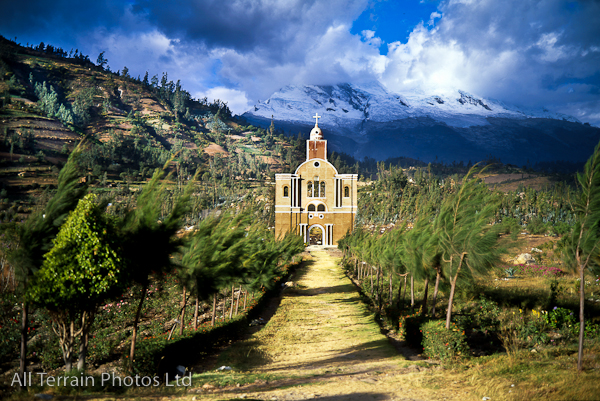
The town of Yungay and its 25,000 inhabitants were buried under the landslide. Many of the inhabitants had sought refuge in the church ,to pray once the earthquake struck. What remains today, captured in this image, is a reproduction of the church facia, along with the lone surviving palm trees in the Yungay cemetery. This monument has been dedicated to all those souls who lost their lives that fateful day.
In Yungay, only 350 residents survived, a poultry 0.014% of the total population. However, in a fortuitous twist of fate, 300 of these survivors were children had been taken to the circus at the local stadium, set on higher ground on the outskirts of the town.
The government has prohibited excavation of the site, so to this day, it remains as an eerie reminder of how powerful nature truly is.


 All Terrain Photography